Monday, October 31, 2022

The Ponte Holiday

One of the landmarks in Florence is the Ponte Vecchio, the Old Bridge. The name fits because this bridge was built in 1335 after the terrible flood of 1333 destroyed the bridge that had connected the two sections of the city on either side of the Arno River. The ancient structure has survived every flood since. As the Germans evacuated Florence in World War II the destroyed every other bridge but let the Ponte Vecchio stand on orders from Berlin.

In Italian the word ponte means bridge. The word also is the name of a card game similar to card with the same name that we are familiar with. A ponte is also the name of an infrequent holiday, an additional day off from work. 


Here are the twelve official holidays that were/are celebrated in Italy in 2022.


See this web site for an explanation of each holiday and for how each holiday is celebrated:  https://www.trip.com/hot/italy-holidays-2022/


Notice that Italy has not adopted the plan that moves public holidays to Monday as we have for most public holidays in the United States. The dates for each holiday are fixed. Some holidays, as a result, fall on Saturdays and Sundays and workers might celebrate the holiday according to tradition but fail to have a day off from work.


Note also that in 2022 four public holidays fell on a Tuesday or a Thursday. In Italy this makes up for the holidays that fell on Saturday or Sunday. It is the custom (but not the law) that many Italians add a Monday or a Friday to a Tuesday or a Thursday holiday. The added Monday or Friday is called a ponte.


Some people must work on the ponte holiday such as bakers and restaurants but may offer reduced hours. For almost everyone the ponte holiday is a gift of the calendar.


Finally, today, October 31, is a ponte holiday in Italy. Tomorrow is the public holiday celebrating All Saints Day. Today many, many Italians will stretch the official Tuesday holiday into a four day weekend. Buona festa!

Friday, October 28, 2022

I Dolci di Patrizia Cosi in Florence

 Patrizio Cosi is a caffetteria and pasticceria located in a residential area of Florence. The coffee bar and pastry shop is located near two small piazzas with lots of foot traffic going by the doors, one door at each end of the small shop. The emphasis of the shop is on different kinds of pastries and snacks but the coffee bar is always busy in the morning when we pass by on our way into the center of the city.

The rules for places like this in Florence vary. In the center of Florence the fancy places with old-fashioned bars usually require that you tell a cashier what you want, pay, and then pick up your coffee and/or pastry after presenting the receipt. Very formal. Such high-brow places also offer service at a bar (al banco) or service at a table (a tavola) for a considerable up charge. Outside the city center and in the smaller towns service is usually more casual.


At Patrizio Cosi the routines are more casual. Simple tables are available for customers who want to sit to enjoy their morning cappuccino and snack. Management only asks that you clear your own table and most people do just that. A sign asks only that customers return their cups and glasses to the bar.


Breakfast pastries
The pastries are the stars of this shop. The pastries come in different types. First are the breakfast treats. Italians have little for breakfast and either on the way to work or in the middle of the morning, a snack is a good idea. Breakfast treats are available well into the day. 


Merende
Second are the merende, more substantial sandwiches for a quick, inexpensive meal. Merende are available from morning until late in the day.


Fine pastries
Third are the fine pastries. Coffee bars often have goodies in the first and second categories and often the breakfast pastries are only of middling quality. Patrizio Cosi has breakfast pastries and elegant pastries made in the store and suitable for your own consumption or for a gift.


There is an interesting Italian custom that you see in places like Patrizio Cosi. People who are invited to lunch or dinner at someone’s home stop at fine pastry shop. The staff place the pastries you select in a presentation box with a paperboard handle for the lunch or dinner guest to present to their host. You wonder if this replaces our tradition of bringing a bottle of wine for the host of a meal.


People are greeting as they arrive and wished well as they leave. One of the curious things you hear in this coffee bar is people leaving for work being wished “Buon lavoro” or something like “Have a good day at work.” Also, after your second or third visit the staff know what you want. They only wait for you to confirm your request.


For a gallery of the sweet goods offered here, see this link:

http://www.pasticceriacosifirenze.it/foto-dolci-patrizio-cosi

Sunday, October 23, 2022

Halloween in Italy

In Florence we are in the days leading up to Halloween or as it is said here, AHH low ween, with the accent on the first syllable. It’s a little surprising to us because the holiday and the celebration seem so native to our society. If it once was, it’s being adopted in Italy and celebrated in similar ways. 

 The word Halloween is borrowed from English. The letter H is barely a letter in the Italian alphabet. In Italian this letter only serves to change the pronunciation of other letters, specifically c and g, in certain spellings. For instance, there is the soft C in cello, the stringed instrument, but a hard c pronounced as a K in the world chilometro for kilometer. The one place you see H in public and standing alone is on the international sign that help you find a hospital. The word in Italian is ospedale but the symbol on the road is an H.

A Halloween outfit
A store window on our street showed an outfit in its window that stopped my eye. The shirt says “dolcetto o schezetto.” The phrase means “a little sweet something or a little trick.” In more straightforward language, it means “treat or trick.” If you put the phrase into an internet translating service, out comes the phrase with which we are more familiar, “trick or treat.” It is interesting how the phrase was reversed from our familiar usage to the usage in Italian.

Note:  the phrase “hugs and kisses” as a salutation exists in Italian but again the terms are reversed. The expression is “baci e abracci” or “kisses and hugs.”


You may know, of course, that Halloween immediately precedes All Saints Day on November 1. That same date in Italy is a national holiday which closes banks, schools, and government offices. The next day, November 2, is The Day of the Dead which is celebrated something like our Memorial Day. Families visit cemeteries and
leave flowers for departed relatives. The ghoulishness with which we celebrate Halloween is similar here with, perhaps, deeper social and religious roots in Italy. 


Kids in Italy dress in similar scary costumes. In our experience, however, the targets of the trick-or-treaters are the many, many small shops that are normally open here until 7:00pm or 7:30pm, hours which are dark here at at the end of October. Young kids are accompanied by the parents and go from shop to shop where they are greeted by merchants who pass out candy. We wonder what happens in the apartments that most Italians live in.


A display of Halloween treats in, of all
places, the produce department
Here, like at home, the grocery stores are ready to supply the sweets for the Halloween celebration. Notice the gaudy display of pumpkins which appear to be for display only, not for sale. The term pumpkin in Italy is the English translation for the Italian word zucca. A zucca looks a lot like a pumpkin but the uses for the zucca seem very different. 


Zucca are not meant for carving, the useful meat of the plant is quite thick. Zucca are large, of course, and in the market you can purchase a slice of zucca, enough for your immediate use, and pay according to the weight. This is the same way that bread is sold which is also reasonable since bread is wonderful the first day but is stale and hard by the third day. There are no preservatives in the bread sold in bakeries.


Pre-filled bags of sweets
Note that the knife ready to cut
a slice to your order.

We use pumpkin in one obvious way, to make pumpkin pie. Italian have many uses for zucca. Here are some recipes at random to show the variety of uses for zucca,
zucca gratinata or zucca with stale bread and familiar Tuscan herbs, tortelli di zucca or pasta stuffed with zucca, mostarda, and sweet biscuits, or risotto alla zucca which uses butternut squash which is also referred to as a zucca. 


The pumpkin spice wave which cannot be ignored at home has not yet crested on Italian shores. 😉


Italian parents may indulge their children. Our local grocery store also offers bags prefilled with sweet goodies for only about $8 at today’s rate of exchange. These already full bags are called Happy Snacks, a term in English for reasons unknown


.

Friday, October 14, 2022

Communal games in Italian cities and towns

In 2013 we were in Florence during the month of March for a special celebration, the 150th anniversary of Italian independence. It was a curious celebration because it was the first time that the holiday had ever been celebrated in Italy. The Fourth of July holiday is so central to our lives that the date itself is capitalized in the US. In Italy it took 150 years to get around to their first celebration.


Poster for the 2022 race in Montepulciano
Italy is barely a normal country. Cooking is regional. Accents differ from town to town. Each area has its own DOC wines and DOC wines are limited to a particular local area by law. For an Italian the best olive oil is always from properties within a few miles of your home. Proverbs remind Florentines not to trust anyone from Pisa, a town 55 miles west of Florence.


There is a name for this bias. Campanilismo is the name in Italy for thinking of yourself and your identity in narrow, local terms. In Italy the campanile is the bell tower that is either next to your cathedral. The bell tower is most visible part of the town or city landscape. The bell tower is a symbol for the place. 


Localism is alive within towns and cities, as well. Within towns and cities there are rivalries between neighborhoods. These rivalries are celebrated in communal games the nature of which vary but which always bring neighborhoods into competition with each other. Every competition ends with a prize that seem to be only a token but the real prize is more likely bragging rights for a year.


The first two competitions described below take place in sizable cities. The next two take place in small towns.


Florence   (population 382,258)


Every year in Florence the four quarters of the city compete against each other in what is called Calico Storico (Historic Soccer.) Each quarter of the city wears a particular color. The game is played on June 24, the day of celebration of St. John the Baptist, the patron saint of Florence. 


Opening ceremony for Calcio Storico
The game itself does not resemble soccer. Rather the game seems more like rugby but played without many rules. The scheme for the game were first set in 1580. The victorious team wins a calf.


A large piazza is spread with sand and the players and officials dress in traditional clothing. While the ceremonies that precede the game involve traditional costunes, the players are mostly shirtless during the game.


To get a sense for the game, please see this video. The game is very free form.


Siena   (population 53,772)


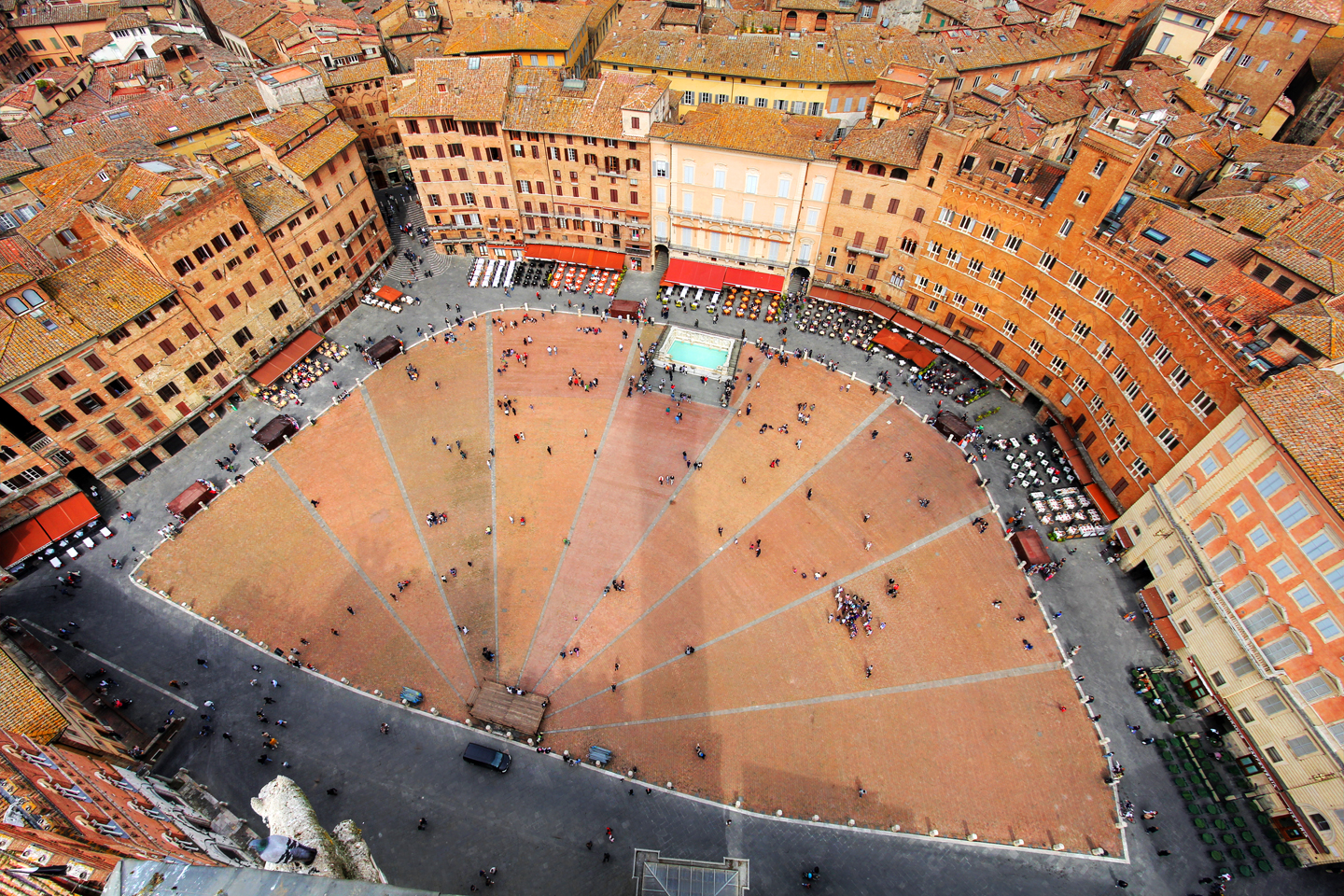
Perhaps the most famous of these communal games is the Palio that takes place in Siena. The competition is a horse race in the city’s famous Piazza del Campo. The piazza is roughly a half circle with, as a result, two very sharp turns. Sod is spread around the outer ring of the piazza. Stands are set up around the track and every window looking over the piazza is filled with spectators.


The competition is between the seventeen neighborhoods or contrade that make up Siena. There are two races each summer, one in July and one in August. In each race ten contrade enter horses and jockeys. The winner is the first horse to cross the finish line. The winning horse may or may not still be carrying a jockey. The race is famous for trickery and sabotage.


What is the prize for winning? 


“Following the tradition, the winner takes home not only the silk painted prize, but also 70 silver coins reproducing the antique coins of Siena’s Republic - this for the 2nd of July - and 50 coins for the 16th of August event. Moreover, the Contrada receives an official document of the victory and the inscription in the general register of the municipality.”  (Source)


Here is a video of August race in 2019. The winning neighborhood celebrated for days and weeks afterward.


Here is everything you’d ever want to know about the Palio. The site is in Italian but you can ask Google for a translation.


San Martino in Pensilis (population 4,769)


The grandparents of one of us emigrated from San Marino, a small town in Molise in southern Italy. This is an agricultural area that produces grain, olive, and grapes for wine. 


A race happens once a year in April on the feast day of St. Leo, the patron saint of the town. The race takes place over a course of a little over 3 kilometers or almost 2 miles. The competitors ride in carts pulled by teams of oxen. Horsemen ride along encouraging the oxen.


The race is call La Caresse in
San Martino in Pensilis

The race begins in the country and ends near the town.


If you wanted an unlikely animal for a race over two miles, you might select a team of oxen. They are slow but powerful but certainly not speedy. Because the animals are in a sprint, there are places along the course where teams of tired oxen are transferred for fresh teams. It is at this point where the drama of the race rises to a crescendo.


Again, the winning cart (or chariot as the locals refer to it) wins the following”


“The winning chariot, on the day of San Leo has the honor of carrying the silver bust of the saint in procession.”  (Source, translated)


Hard to believe? Take a look at the video.


Montepulciano
(population 14,033)


Of course, Montepulciano has its own annual competition. And, of course, the competition involves wine. Montepulciano is a wine town and the competition involves wine barrels, large, empty wine barrels.


You should notice that the name of the town begins with mont. The letters are suggestive of the word mountain. Many towns in Italy were founded a thousand years ago when having a defensible position was essential for survival. In the area around Montepulciano are other towns named Monticchello, Montalcino, Montefolonico, Monteriggioni, Montevarchi, and others. This should suggest that the towns are located on top of hilly terrain. Montepulciano certainly is such a town.


The annual competition is called Il Bravìa delle Botte. Before the actual race to the top of the town, representative of each contrada parade in traditional costumes. Examples can be seen on this web page.


 The Bravìo is the prize that goes to the winning team, a cloth with an image of the patron saint of the town. The barrels involved in this race are wine barrels, empty wine barrels that weigh about 175 pounds. The course is about 1700 meters or a little over one mile.


Eight teams start at the bottom
of this hilly town
The race involves eight teams representing each of the eight contrade of Montepulciano. The start line is at the bottom of the town. The teams push their barrels to the central piazza at the top of the town. The entire course is uphill.


There are eight starting positions for the teams of two persons who represent each contrada. The course begins with a quite steep h
ill, so steep that we are careful to limit the number of times a day that we walk up and down that slope and we are not pushing heavy, oak wine barrels.


For a collection of photos of the race, the ceremonies preceding the race, and the celebration of the winner, see this page.


Here is the video of the men in the 2022 race:  Talosa vince!


Monepulciano is a progressive town. In recent years the town has run another similar race called the Le Dame della Botte (The Women of the Wine Barrels.) The course is shortened and the teams are made up of women from the eight contrade.


And here is the video of the first race of Le Dame della Botte in 2017:   Le Dame della Botte 2017 - 1à edizione


Note: We’ve only seen one of these communal competitions, the Palio in Siena. One of us was a junior in college and we were traveling with friends in the summer. Somehow we got tickets to the famous horse race. We noticed that the tourists all ended up in the stands that were in the sun. The locals all had seats in the shade. The center of the piazza was shoulder-to-shoulder jammed with spectators.


The race took less that two minutes but the excitement had been building for days. The parties for the winning contrada went on deep into the night.


I have a odd memory from that day in Siena. I asked a local person how to translate the word contrada. The person responded contrada means republic. From that person’s point of view Siena, a town of 50,000 was made up of 17 different republics. Localism is alive and well in Siena and in the entire country of Italy.

The Ponte Holiday

One of the landmarks in Florence is the Ponte Vecchio , the Old Bridge. The name fits because this bridge was built in 1335 after the terrib...